Light of Tech Under Heavy Loads — The Evolution of Exoskeletons for Taishan Porters
Why Do Taishan Porters Need a Dedicated Exoskeleton?
Mount Tai features over 6,000 steep and winding stone steps. While traditional lower-limb exoskeletons reduce walking fatigue, they fall short in real-world portering scenarios: a porter’s core issue is not just leg strain, but shoulder and lower back compression. With only leg assistance, heavy loads still press directly down on the shoulders and spine, easily causing severe occupational injuries such as lumbar disc herniation and shoulder joint strain.
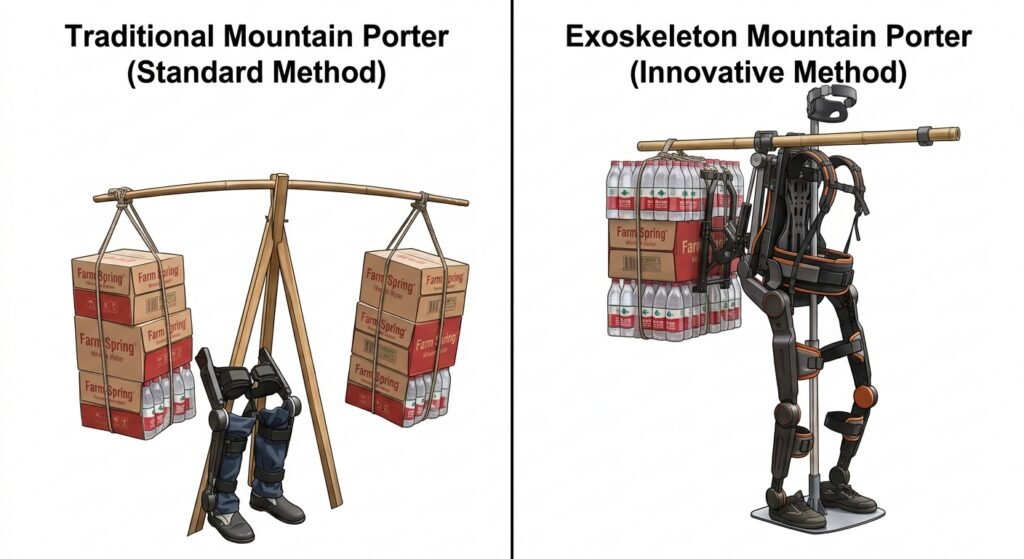
Design drawings of an innovative exoskeleton
Traditional Exoskeleton vs. Porter-Dedicated Innovative Exoskeleton
| Dimension | Traditional Lower-Limb Exoskeleton | Porter-Dedicated Full-Body Innovation |
| Assistance Range | Lower limbs only (knees, hips) | Full torso coordination (leg power + back support + shoulder offloading) |
| Shoulder Pole Load | Pole rests directly on the porter’s shoulders | Load transfer: Pole rests on a frame; weight goes straight to the ground |
| Back Protection | No back support or basic waist belt only | Rigid spine & wide lumbar support: Locks posture and disperses bending torque |
| Cargo Adaptability | Suited for backpacks or rear-mounted cargo | Tailored design: Balanced for shoulder poles and stacked beverage boxes |
| User Experience | Legs feel lighter, but shoulders and back still ache | “Load remains elevated, weight stays off the body”; reduced stress |
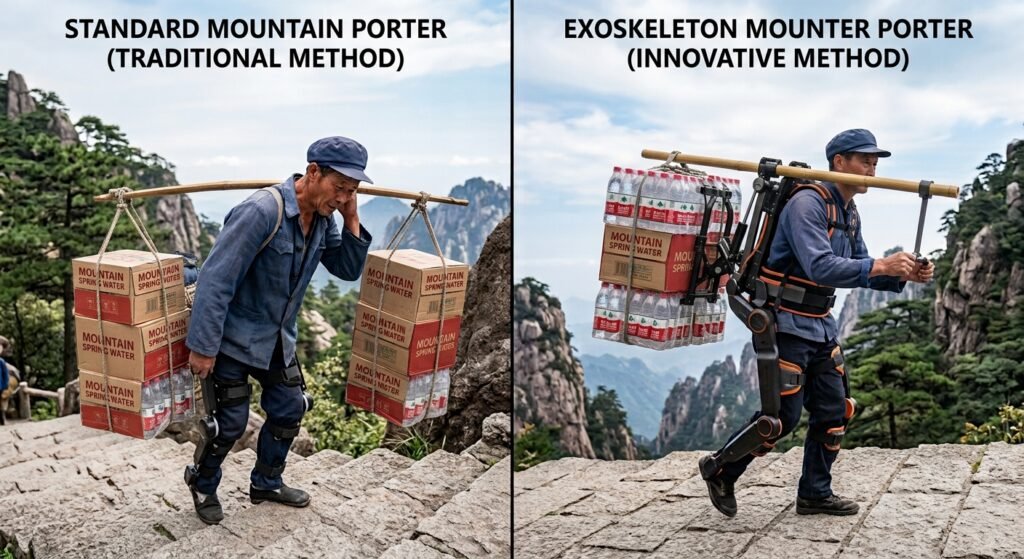
Conceptual illustration of the use of an innovative exoskeleton
4 Core Innovations for Taishan Porters
Direct Load Offloading Bracket High-strength metal hooks extend from the frame to hold the shoulder pole. Heavy downward force bypasses human shoulders and transfers directly into the ground through the rigid structure.
Integrated Spine & Lumbar Support An ergonomic rigid spine framework locks user posture during steep ascents. The wide, reinforced waist belt absorbs load sway, protecting the lower back from torque and long-term strain.
Smart Stair-Climbing Power Delivery Precision inertial sensors detect stair-climbing movement instantly. Adaptive motors apply smooth upward thrust at the hip and knee joints, significantly reducing quadriceps fatigue.
High-Altitude Stability & Balance Constructed with a carbon fiber and aviation alloy hybrid frame for low self-weight. A lower center of gravity ensures agility when dodging tourists or stopping on narrow mountain steps.
“Shifting the weight of centuries from human shoulders to a resilient mechanical spine.”
This innovative exoskeleton is more than a technological upgrade—it is a thoughtful shield for dedicated workers. It honours the endurance of Mount Tai’s porters while leveraging modern technology to protect their backs and knees.