Origins: From Ritual Laborers to a Professional Trade
This was never a job invented out of nowhere. It grew, step by step, out of Mount Tai’s long history of imperial ritual, temple construction, and — eventually — tourism, gradually hardening into a fixed occupation passed down through generations.
The Imperial Era: Laborers for the Sacred Mountain
Since antiquity, Mount Tai has been one of the most sacred sites for imperial rulers, who climbed it to perform the fengshan rites — grand sacrificial ceremonies meant to affirm their legitimacy before heaven and earth. These ceremonies, along with the large-scale construction of temples and shrines along the mountain, required enormous quantities of stone, timber, and ritual offerings to be carried up steep, narrow paths that no cart or animal could navigate. That labor fell to local mountain villagers and conscripted laborers — the earliest ancestors of what would later become the professional mountain porter.
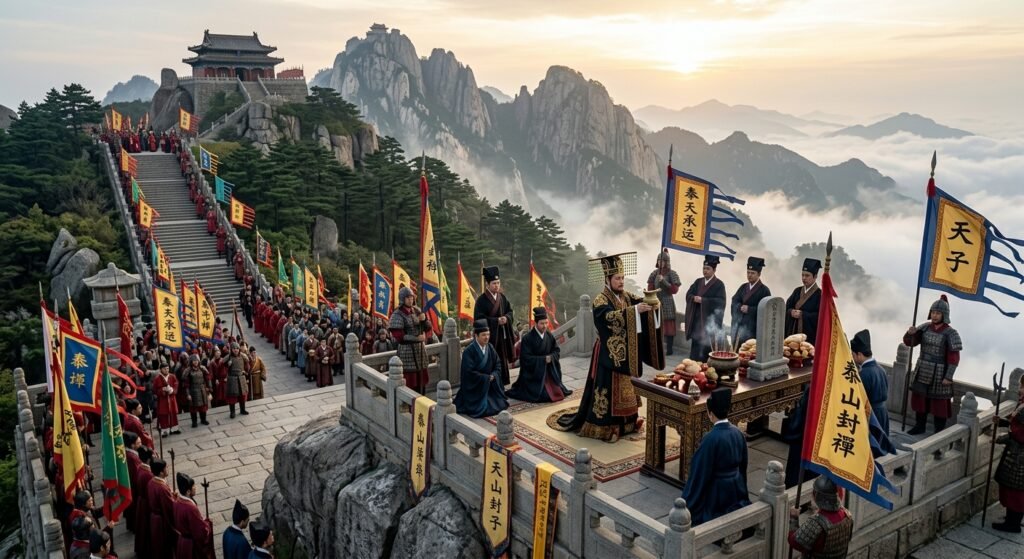
An impression of the ancient Chinese imperial Fengshan ceremony.
A Trade Takes Shape
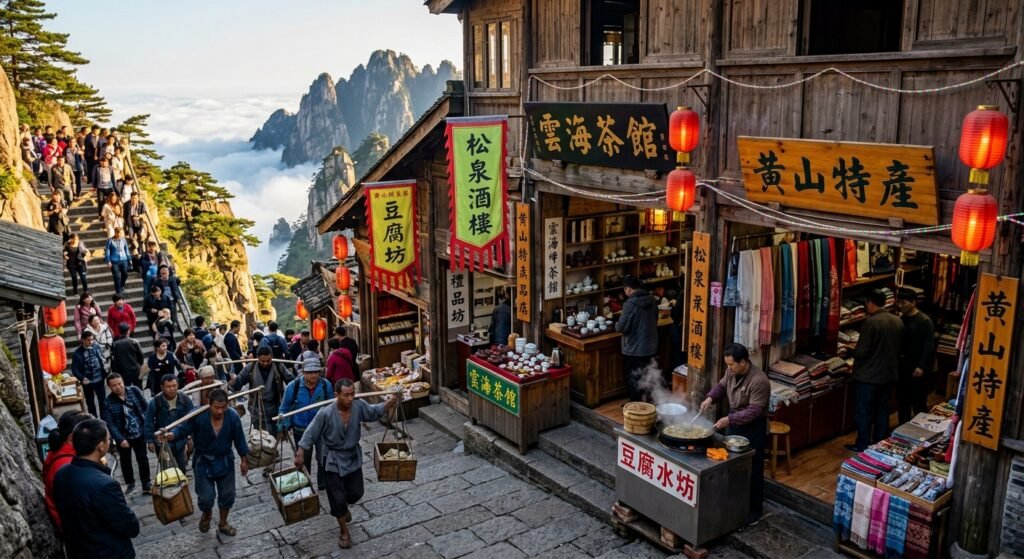
As shops, inns, and pilgrim lodges sprang up near the summit to serve travelers and worshippers, the demand for supplies became constant rather than occasional. Grain, daily necessities, and building materials all had to move up the mountain the same way — carried on human shoulders. It was during this period that portering solidified into a fixed profession, complete with established routes, informal codes of conduct, and pricing conventions. The trade was largely hereditary, passed down among farming families from Tai’an, Licheng, and the surrounding countryside, generation after generation.
Entering the National Imagination
The porters might have remained a purely local phenomenon were it not for one essay. When writer Feng Jicai published The Mountain Porter, later included in China’s national language textbooks, the image of a porter climbing “one deliberate step at a time” — steady, unhurried, unwavering — became a shared memory for an entire generation of readers. From that point on, the mountain porter stopped being simply a laborer and became something closer to a national symbol: a living metaphor for perseverance and quiet endurance.
Endurance, steadiness, and persistence — the mountain porter was never just an occupation. It became one of the defining images of China’s working spirit.